



Medical Research Course
This lecture series is intended for healthcare students and professional who are interested in learning and improving medical communication skills. This series of lectures in the intended sequence, provides foundations to strengthen writing skills with practical application. Goals of each lecture series is described individually.
By the end of this lecture series, the participants will be able to:
- Understand the principles and ethics of research, especially biomedical research
- Understand the various settings within medical writing (internal reports, poster, case reports, review articles, grants, etc.), editing, targeted literature search, appropriate medical terminology, appropriate style for medical and scientific writing.
- Demonstrate the command on deciphering and writing good clinical case reports
- Understand various types of research funding opportunities and components of successful NIH grant proposal.
- At the end, student should be able to write and publish a peer-reviewed masscult.
WHO SHOULD ENROLL
International Medical Graduates
HOW IT WORKS

COURSE LENGTH
4 WEEKS

DURATION
20 HOURS

CLASS SIZE
UNLIMITED

EFFORT
5 HOURS PER WEEK

FORMAT
100% ONLINE

MODEL
FACULTY-LED
RESEARCH LECTURE SERIES
Research Topics
1. Research 101
The course is designed for healthcare students and practitioners, research staff members and coordinators, interested in learning about research conduct and leading various research projects. Medical research is an integral part of medical school’s curriculum worldwide and a requirement for most residency programs in the United States.
Medical Student Research Requirement at US Medical Schools (American Association of Medical Colleges (AAMC))
https://www.aamc.org/data-reports/curriculum-reports/interactive-data/medical-student-research-requirement-us-medical-schools
Introduction to Research in Residency (The New England Journal of Medicine (NEJM))
https://resident360.nejm.org/content_items/1841
Topics covered in this lecture:
✓ Introduction to the research design
✓ Understand research terminology
✓ Ethical and legal principles of research, challenges and approval processes
✓ Quantitative, qualitative research
✓ Thorough literature review process
✓ Critically analyze published research (literature review)
✓ Understand research terminology
✓ Ethical and legal principles of research, challenges and approval processes
✓ Quantitative, qualitative research
✓ Thorough literature review process
✓ Critically analyze published research (literature review)
2. Writing & reviewing your work for publication and ERAS
In the words of Dr. Francis Crick (Noble Laureate, who reposed the double helix structure of the DNA molecule), “There is no form of prose more difficult to understand and more tedious to read than the average scientific paper”. Writing a succinct and lucid medical report for internal use and for peer-reviewed publication and presentation, requires underrating the art and science of good academic writing as well much practice under the guidance of expert authors.
The Scientific and Medical Writing lecture series is designed to healthcare students and practitioners, using lectures and published (peer-reviewed) medical manuscripts to teach the fundamentals of medical writing, editing, and medical communication needed to enter the profession and to succeed as skilled medical communicator.
Topics covered in this lecture:
✓ Abstract writing
✓ Poster presentation
✓ Writing medical reports, clinical case reports, SOAP notes
✓ Writing original research and review articles
✓ Manuscript submission and peer-review process
✓ Grant writing
✓ PhD dissertations
✓ Book writing
✓ CV writing
✓ Personal statement and essay writing for medical school admission and residency application
3. Improving your case reports: Get it Published!
Clinical case reports make an amazing teaching tool for healthcare professionals. The tend to be short and often the first type of manuscript published by most medical students and the residents. Putting together a well written clinical case report requires understanding the components and following the specific style of the targeted journal. This also requires meticulous history taking, proper differential diagnosis, clinical evidences (Lab reports, imaging studies, etc) and the outcome of interventions with lesson learned.
We will utilize various published case reports in peer-reviewed journal (by the faculty member him/herself as well as others) to highlight the components of a well written report, rare diseases an unusual presentation of known cases, and thus will help in their practice.
Topics covered in this lecture:
✓ Learners will obtain the fundamental and practical knowledge on how to write an impactful case report attractive for peer-review journal publication.
✓ Learners will have the opportunity to develop an abstract and early draft for publication.
✓ Learners will have the opportunity to develop an abstract and early draft for publication.
4. Developing a research proposal: NIH style
In a pursuit of academic medicine, medical scientists (doctors with strong research background, often have PhDs too) have to write grant proposals and secure extramural funding to start and sustain a research lab. The US National Institutes of Health (NIH), is the biggest health funding agency in the U.S and the world, with an annual budget of US$39 billion (2019). Thus learning how to write and submit NIH specific research proposal (grants and contracts) is very relevant and a must for anyone interested in medical training opportunities and enter the academic medicine.
Topics covered in this lecture:
✓ Developing Hypothesis and Specific Aims to initiate a research proposal is an essential skill that must be learned before conducting an original research study.
✓ At the end of the Lecture, participants will be prepared to develop a research question.
✓ At the end of the Lecture, participants will be prepared to develop a research question.
5. Writing Your 1st Systematic Peer-Reviewed Article
Having a peer-reviewed publication makes it lot more feasible to get a residency (and good ones) in the US hospital. Almost all the US hospitals required doctors to publish or submit at least one or more manuscripts before licensing. If doctors want to purse the academic medicine, they must be proficient in both the areas of research and writing (papers and grant).
In this course, each student is required to re-write one of the previously published clinical case reports or a review article, and make a presentation. It allows student to overcome fear of communication (more important for foreign medical graduates) as well as a chance to write an article and work with the professor one-to-one to get the feedback to further polish their skill. This has led to peer-reviewed publications with students in the past. The clinical case reports assigned to the students will also help student to learn new and unusual clinical cases, examples of good SOAP notes, complex differential diagnoses, treatment and follow up protocols (good universal doctoring skills).
Topics covered in this lecture:
✓ Mention and understand the basic steps of a Literature Review
✓ Know how to navigate through search tools/databases
✓ Construct PICO tables for a given research study
FACULTY
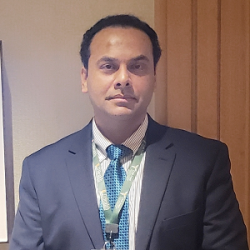
Syed A. A. Rizvi, PhD., M.S., M.B.A.
Research Director
Adjunct Professor, Department of Molecular Biology and Chemistry, Christopher Newport University
Associate Professor, School of Pharmacy, Hampton University